

Every shot I composite stands on more than a hundred years of tricks, inventions and stubborn people. This is the story of visual effects told through the films that changed the job: from a magician who stopped his camera in 1896 to the LED walls and machine learning of today, with every Oscar for visual effects, the videos worth watching and the books worth reading.
Index
- 01. Photography: the first composites
- 02. Before cinema: freezing motion
- 03. Edison, the Lumières and the birth of cinema
- 04. The first tricks: stop, cut, replace
- 05. Georges Méliès, the magician
- 06. Glass shots, mattes and the rotoscope
- 07. Miniatures and monsters: from The Lost World to King Kong
- 08. The optical printer and the first Oscars
- 09. Blue screen, sodium vapour and colour difference
- 10. Ray Harryhausen and stop motion
- 11. 2001: A Space Odyssey
- 12. Star Wars and the birth of ILM
- 13. The golden age of optical effects (1964-1982)
- 14. The computer arrives: Westworld, Tron, the stained-glass knight
- 15. The digital revolution: T2, Jurassic Park, The Matrix
- 16. The machines of the digital studio
- 17. Compositing goes digital: Shake and Nuke
- 18. Digital characters and performance capture
- 19. The physics of light: Gravity and Interstellar
- 20. The price of the work: Life of Pi and Rhythm & Hues
- 21. LED volumes and virtual production
- 22. Today: small teams, Dune and machine learning
- 23. The studios that made VFX history
- 24. 50 films every VFX artist should watch
- 25. Quiz: how much VFX history do you know?
- 26. Visible and invisible effects: a little theory
- 27. Every Oscar for visual effects
- 28. Videos to watch
- 29. Books on the history of VFX
- 30. Sources and image credits
01. Photography: the first composites
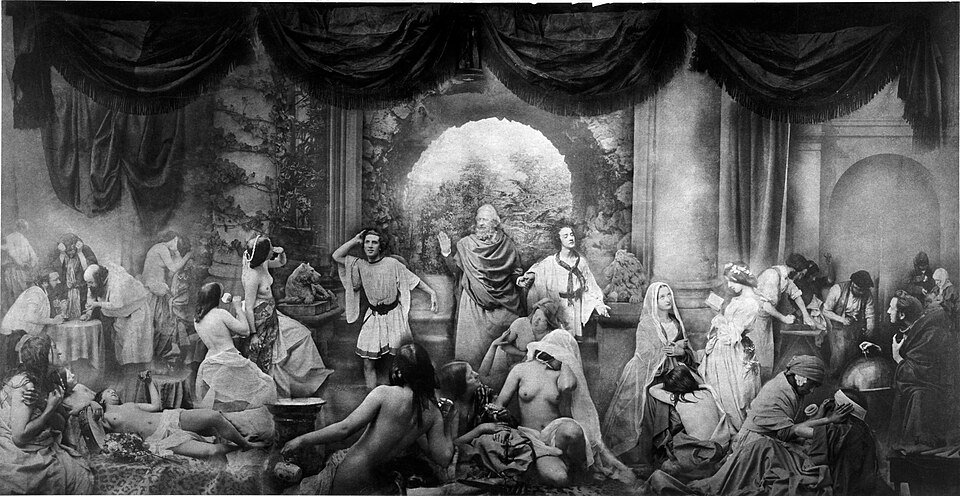
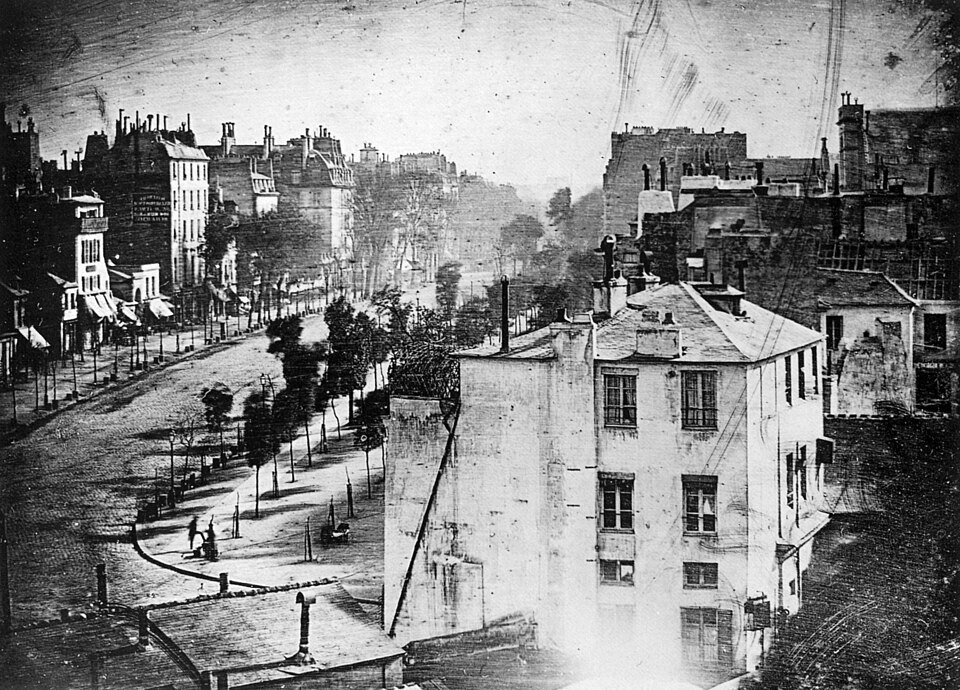
Visual effects are older than cinema. In 1839 Louis Daguerre's process, the daguerreotype, was presented in Paris: the first practical photograph. Within twenty years photographers were already combining several pictures into one.
In 1857 the Swedish photographer Oscar Gustave Rejlander made The Two Ways of Life, an allegory with dozens of figures arranged like a painted fresco: on one side work, family and faith, on the other idleness and vice. He couldn't light and pose all those people in one exposure, so he photographed them in small groups and printed some thirty negatives one after the other onto the same sheet, masking everything but the part he needed each time. It is a combination print: in our words, a composite of thirty-odd layers, made in a small studio.
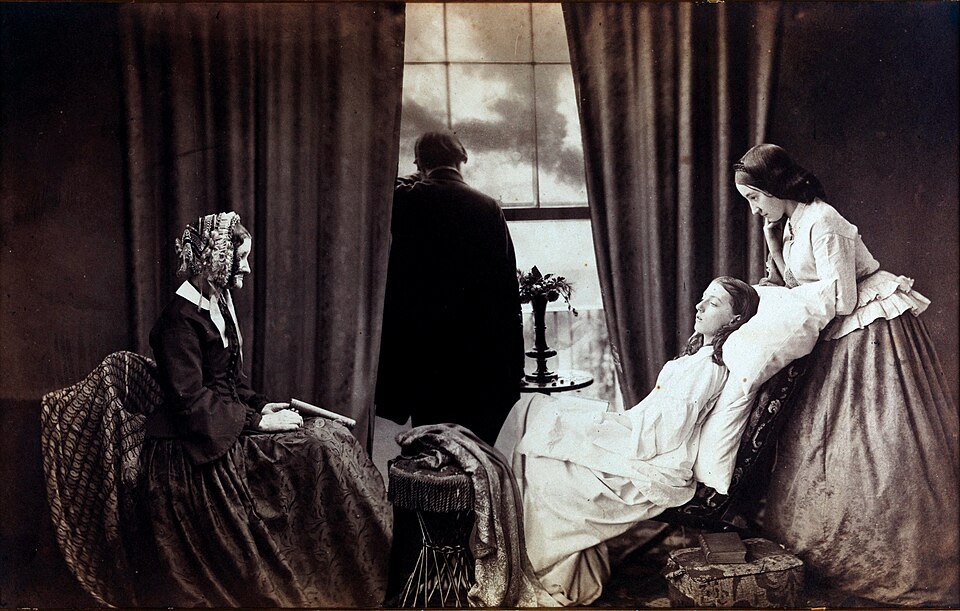
A year later Henry Peach Robinson printed Fading Away (1858) from several negatives, partly because the plates of the time could not record both a bright window and a dark room in one exposure. It is the same problem we solve today with a sky replacement or an HDR merge.
02. Before cinema: freezing motion
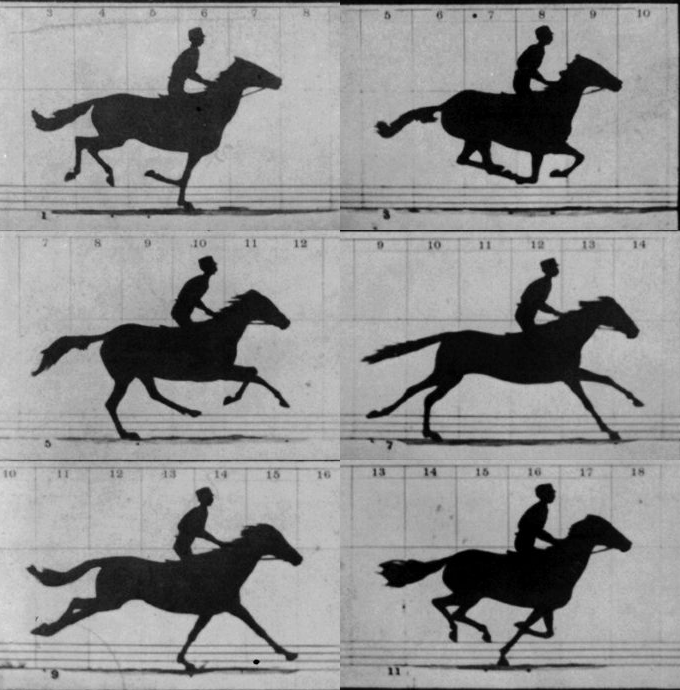
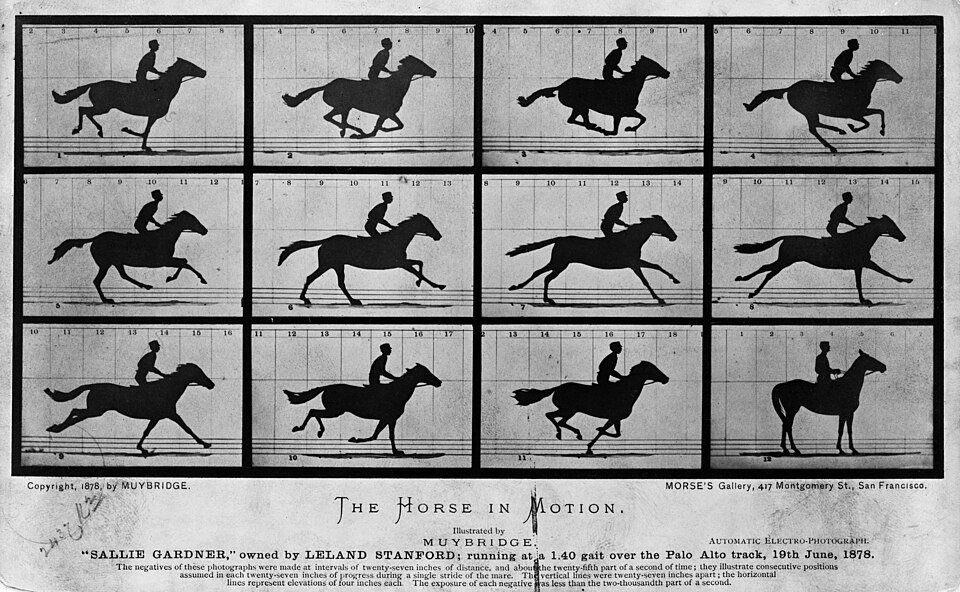
Visual effects start before films do. In 1878 Eadweard Muybridge lined up a row of cameras along a race track and proved, frame by frame, that a galloping horse lifts all four hooves off the ground. It is the first time an image showed something the eye could never see, and it is still what we do: take time apart, and put it back together.
Magic lanterns, phantasmagoria shows and stage illusions such as Pepper's ghost (a sheet of glass that reflects an actor hidden off stage) had already taught audiences to enjoy being fooled. Cinema inherited all of it.
03. Edison, the Lumières and the birth of cinema
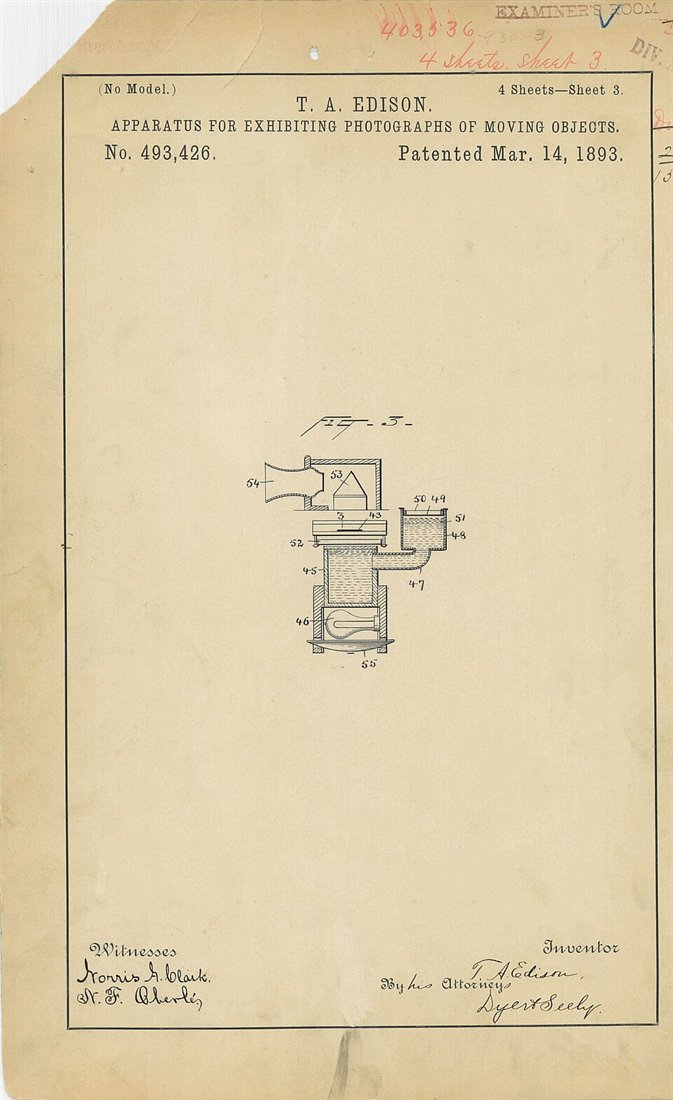
Thomas Edison's company developed the Kinetoscope: a box where one person at a time, looking through an eyepiece, watched a short loop of 35mm film. It reached the public in 1894, in parlours where you paid to look.
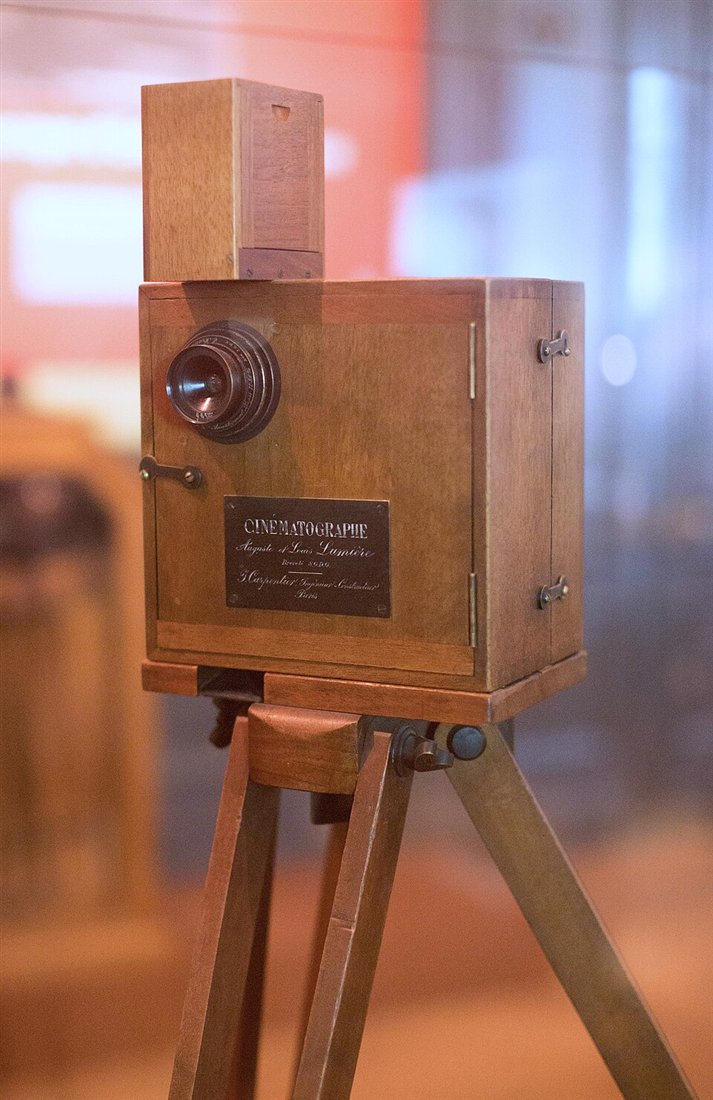
In France, Auguste and Louis Lumière patented the Cinématographe in February 1895: one light, hand-cranked box that was camera, printer and projector at the same time. On 28 December 1895 they projected their films to a paying audience in Paris, Workers Leaving the Lumière Factory among them. Cinema, as an image on a screen watched together, starts there. The Lumières sold and sent their machines around the world, and a whole generation of filmmakers started with one.
04. The first tricks: stop, cut, replace
In 1895, for the Edison company, Alfred Clark shot The Execution of Mary Stuart. Just before the axe falls the camera stops, everyone freezes, the actress is swapped for a dummy, and the camera starts again. On screen the head rolls. It is the stop trick, or substitution splice: the first visual effect, and the ancestor of every cut we hide today.
In 1903 Edwin S. Porter's The Great Train Robbery used matte shots: a train passing outside the window of the telegraph office, and the landscape rushing past the open door of the express car, were exposed separately into areas of the frame kept black the first time. Two exposures, one image: compositing was born on the negative.
05. Georges Méliès, the magician
Georges Méliès was a stage magician in Paris. By his own account, his camera jammed while filming a street; when he projected the film, a bus turned into a hearse. He understood at once what it meant and built a studio of glass to make hundreds of films full of tricks: substitutions, multiple exposures, dissolves, painted sets, miniatures, the same actor several times in one frame.
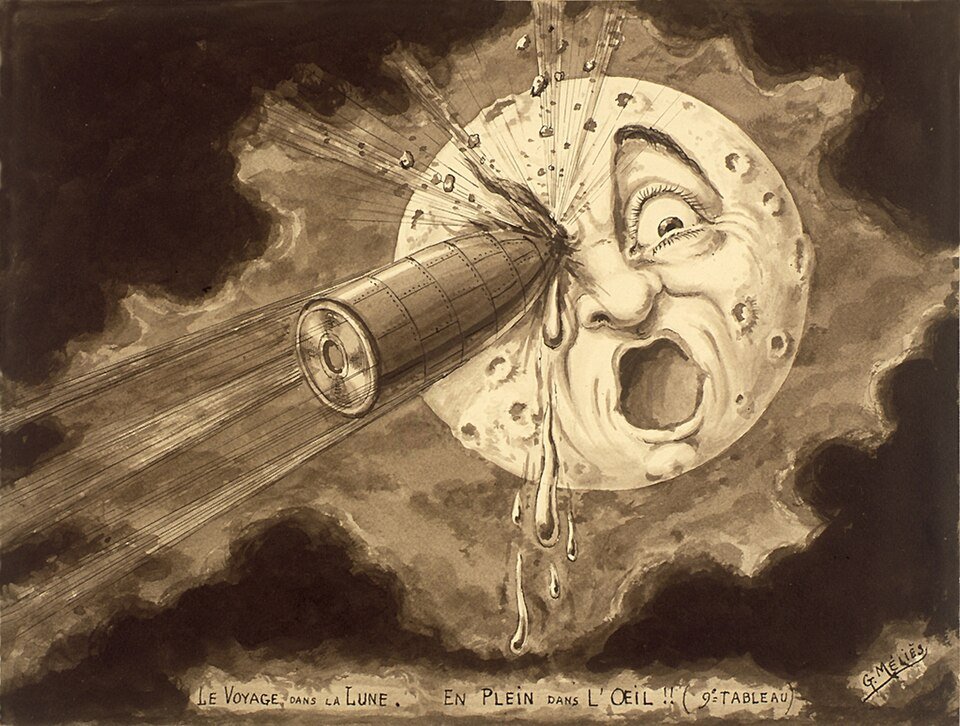
A Trip to the Moon (1902), with the rocket in the eye of the Moon, is his most famous image and probably the most famous early film of all. He treated every frame as a designed picture, which is what a compositor still does.
Méliès had tried to buy a Cinématographe from the Lumières and was refused, so he built his own camera. His studio in Montreuil, Star Film, was a glass house full of machinery, painted sets and costumes. The tricks he used, and in many cases made popular:
- The substitution splice: stop the camera, change something, start again: appearances, disappearances, transformations.
- Multiple exposure: run the same film through the camera more than once, for ghosts and visions.
- Masks and counter-masks: cover part of the frame, expose, rewind, cover the other part, expose again. In The One-Man Band (1900) he plays seven musicians in the same shot. It is the split screen, the first matte and holdout.
- Scale tricks: in The Man with the Rubber Head (1901) his own head grows and shrinks, filmed by moving it towards the camera and double-exposed onto the scene.
- Dissolves and hand colouring: transitions made in camera, and frames painted by hand, one by one.
- Stories in many shots: scenes that follow each other in time and space, at a time when most films were a single shot.
His films were copied and sold without paying him, the market changed, and Star Film went out of business in the 1910s. Méliès ended up selling toys at the Montparnasse station, until critics rediscovered him at the end of the 1920s.
 Georges Méliès: Master of Illusion
06. Glass shots, mattes and the rotoscope
In 1907 Norman Dawn painted the missing parts of old buildings on a sheet of glass placed in front of the camera, for Missions of California: the first glass shot, and the start of matte painting. Soon the painting moved from glass on set to a separate pass, with the live action and the painting joined on the negative through a matte and its inverse, the counter-matte. Every Merge over a holdout in Nuke still works that way.
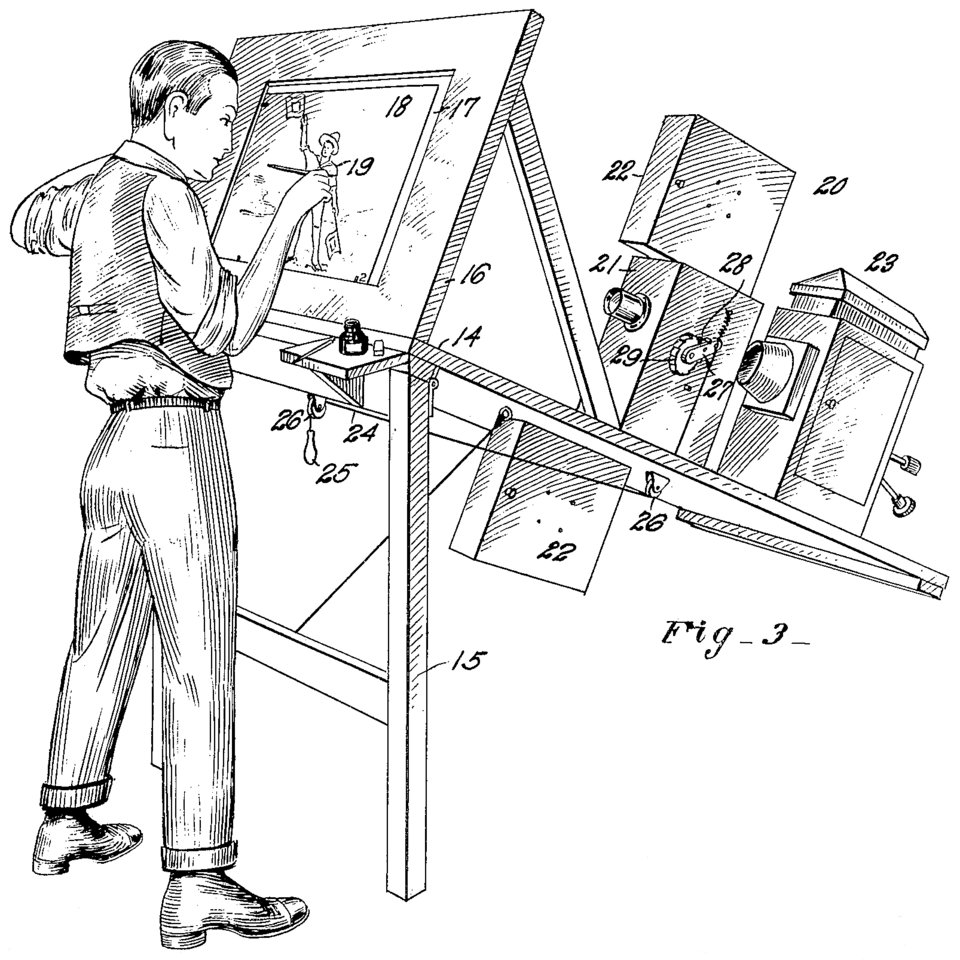
In 1917 Max Fleischer patented the rotoscope: a projector throws live-action frames onto a drawing table, one by one, so an animator can trace them. A hundred years later "roto" is the first job of most junior compositors.
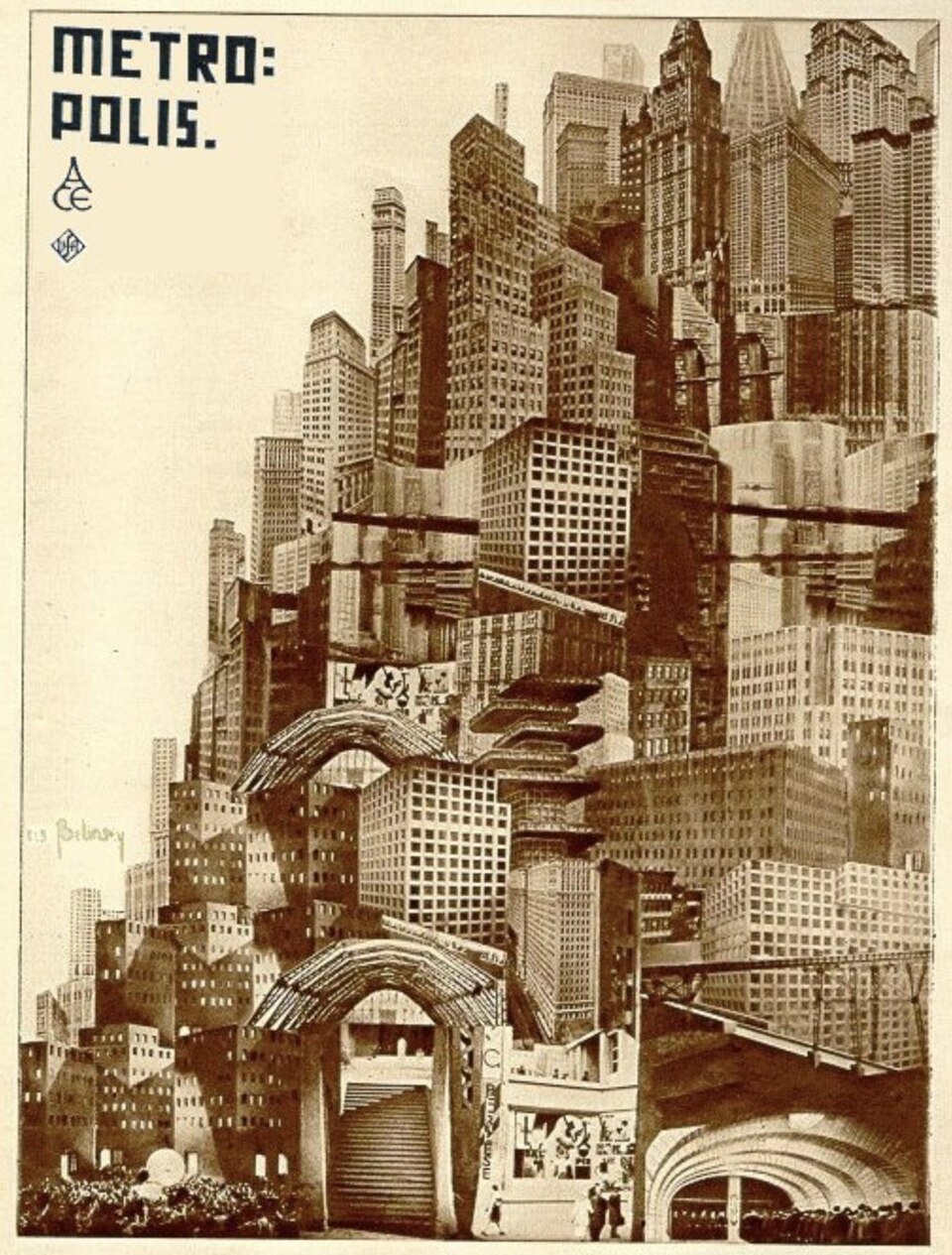
In Metropolis (1927) Eugen Schüfftan used angled mirrors with part of the silvering scraped away, so actors and miniature sets appeared together in the camera: the Schüfftan process.
How matte painting evolved
- Glass shot on set: the painting on glass, a couple of metres in front of the locked-off camera, matched to the real set by eye. The light had to match the painting, so a whole day could go into one shot.
- Original negative matte (latent image): on set, the part of the frame to be painted was blacked out on the glass, so that area of the negative stayed unexposed. Back in the studio the artist painted the missing part using test frames as reference, then the same original negative was exposed a second time, only where the painting was. No ghosting, and no copy generation; but one mistake ruined the original.
- Bi-pack contact matte: to protect the original, the action was printed onto new film through the camera, with the developed footage running in contact with fresh negative. A black matte held out the painted area; a second pass with the painting lit and a black background filled it. Safer and possible on footage shot without planning, but one generation softer.
- Rear projection matte: the footage projected from behind onto a sheet of glass, the painting made directly around it, and the result re-photographed.
- Digital matte painting: from the 1990s, the painting is made in Photoshop and later in 3D (camera projection), and composited with the plate. Still one of the most common visual effects in any film.
Many of these shots are invisible, which is the point. In Hitchcock's Vertigo (1958) the bell tower of the Spanish mission was not there: it was added with a matte. Harrison Ellenshaw, who painted mattes for Star Wars at ILM, liked to say that a matte painting tells a story without anyone noticing the trick.
07. Miniatures and monsters: from The Lost World to King Kong
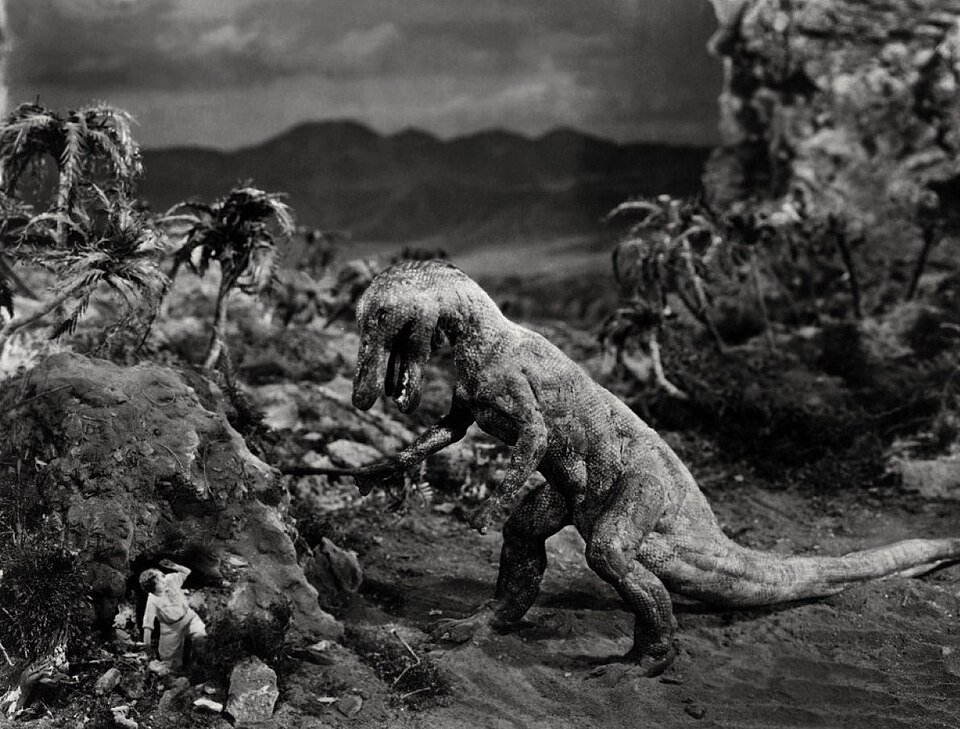
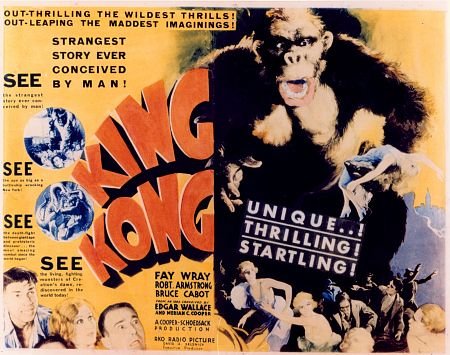
Willis O'Brien animated the dinosaurs of The Lost World (1925) one frame at a time, as puppets with metal skeletons, on miniature sets mixed with live action. Eight years later he did it again for King Kong (1933), with miniature rear projection: tiny screens inside the miniature sets, so actors filmed earlier could appear next to the animated gorilla.
Kong is the first time a creature had to act, and audiences cared about him. It is the line that runs straight to Gollum and Caesar.
08. The optical printer and the first Oscars
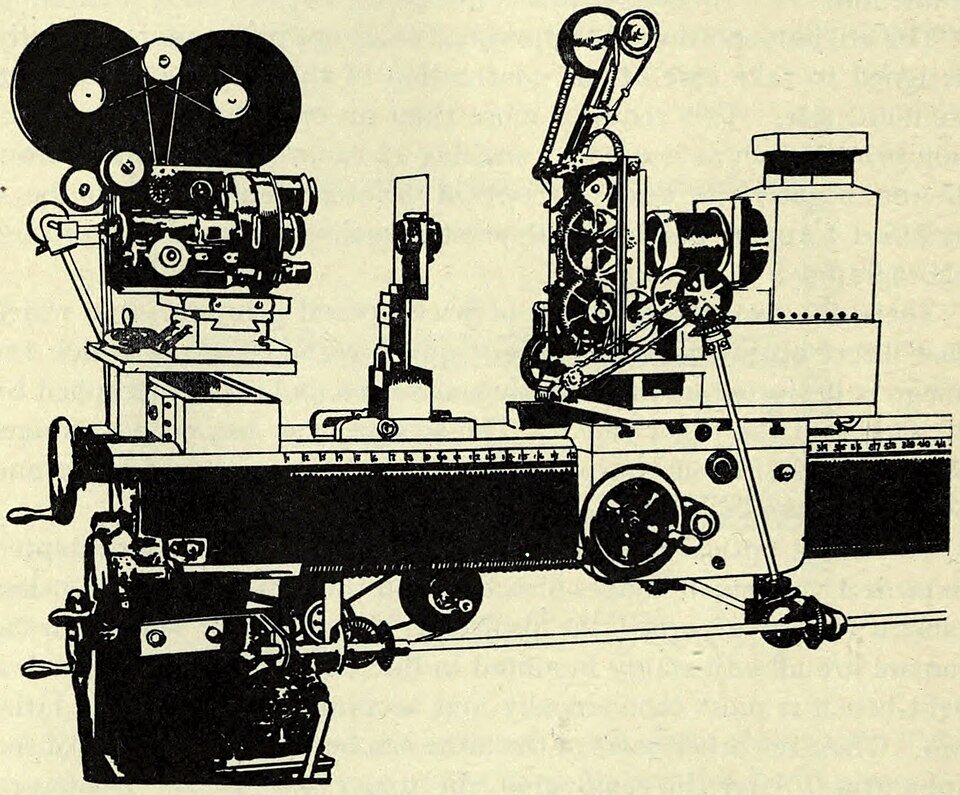
The optical printer is a projector pointed into a camera: it re-photographs film, frame by frame, so you can combine elements, add dissolves, reposition, slow down, repeat. Linwood Dunn's Acme-Dunn printer made it a standard tool, and Dunn's optical work is all over Citizen Kane (1941). For fifty years compositing meant this machine, and every extra generation of film meant more grain and less sharpness: the reason old composites look the way they do.
The Academy gave a Best Special Effects award for the first time for the films of 1939: the winner was The Rains Came, with its earthquake and flood. The next year The Thief of Bagdad won with a blue screen process developed by Larry Butler.
 Parting the Red Sea through the years
09. Blue screen, sodium vapour and colour difference
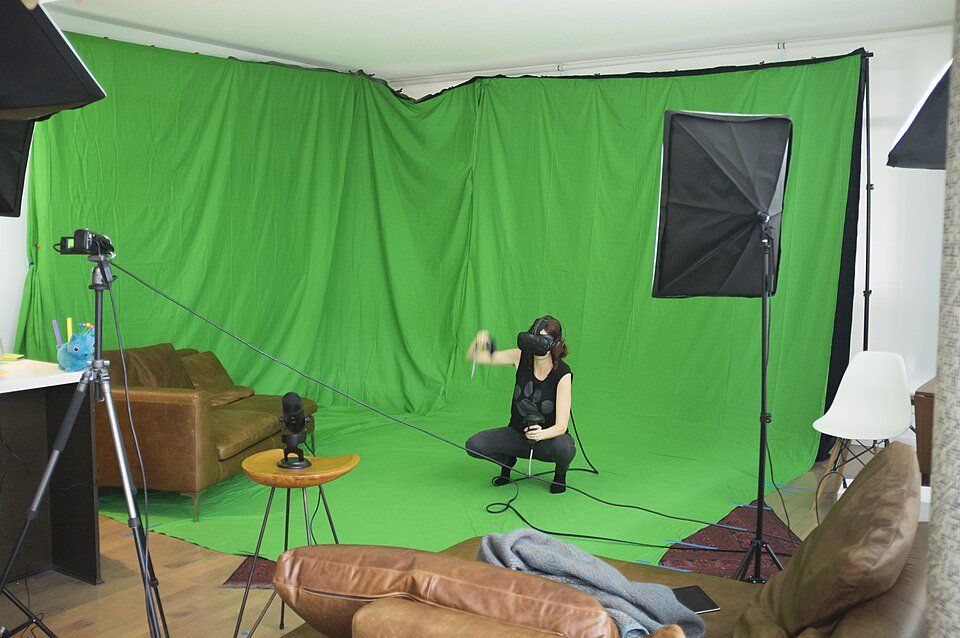
Pulling a clean matte from a coloured background is a hundred-year-old problem. Petro Vlahos solved most of it: his colour-difference blue screen process was used on Ben-Hur (1959), and the idea behind it, comparing the blue channel with the others, is the same maths inside every keyer we use today. I explain it step by step in The Maths of Keying.
Vlahos also developed the sodium vapour process: actors in front of a screen lit by sodium lamps, a special prism splitting that narrow yellow light into a separate film, and a near-perfect matte. Disney used it on Mary Poppins (1964), which won the Oscar for special effects. Vlahos later founded Ultimatte, and the Academy honoured his matting inventions more than once.
 Disney: from sodium vapour to StageCraft
10. Ray Harryhausen and stop motion
Ray Harryhausen saw King Kong as a boy, then worked with Willis O'Brien on Mighty Joe Young (1949), which won the Oscar. With "Dynamation" he split the live-action plate with mattes, so his creatures could move both behind and in front of the actors. The skeleton fight in Jason and the Argonauts (1963) took months of work for a few minutes of film, and generations of VFX artists name it as the scene that made them choose this job.
In the same years George Pal, a Hungarian-born animator famous for his stop-motion "Puppetoons", produced the science-fiction films that ruled the special effects Oscars of the 1950s: Destination Moon, When Worlds Collide, The War of the Worlds, Tom Thumb and The Time Machine, five winners in ten years.
 How Ray Harryhausen combined stop motion and live action
11. 2001: A Space Odyssey
Stanley Kubrick's 2001: A Space Odyssey (1968) set a new bar for realism: front projection for the African landscapes of the opening, enormous detailed models shot slowly for depth of field, and Douglas Trumbull's slit-scan machine for the Star Gate. It won the Oscar for special visual effects, the only Oscar Kubrick ever won.
 Douglas Trumbull on 2001: A Space Odyssey
12. Star Wars and the birth of ILM
For Star Wars George Lucas founded Industrial Light & Magic in 1975, in a warehouse in Van Nuys. John Dykstra's team built the Dykstraflex, a camera on a computer-controlled rig that could repeat the same move as many times as needed: motion control. Every pass of every spaceship could now be shot separately and composited with the same camera move, the same idea as rendering CG passes today. The film won the Oscar for visual effects (the category's new name) in 1978.
ILM went on to shape almost every chapter of this story, and many of the people who built the digital tools we use started there.
 Star Wars visual effects, from AT-ATs to tauntauns
13. The golden age of optical effects (1964-1982)
Before computers, effects reached a level of craft that still holds up. Models, matte paintings, front and rear projection, animatronics and the optical printer, combined by people who knew photography inside out:
- 1964, Mary Poppins: Disney mixes live action and hand-drawn animation with the sodium vapour process; an Oscar for Peter Ellenshaw, Eustace Lycett and Hamilton Luske.
- 1968, 2001: A Space Odyssey: weightless space, front projection and slit-scan.
- 1971, Bedknobs and Broomsticks: Disney again, animation and live action together, Oscar.
- 1975, Jaws: the mechanical shark, nicknamed Bruce, broke down so often that Spielberg showed it less, and the film is scarier for it. A lesson every VFX artist should remember: what you don't show can be stronger.
- 1977, Star Wars: motion control, and ILM.
- 1977, Close Encounters of the Third Kind: Douglas Trumbull's clouds made by injecting paint into a tank of water, the glowing mothership model, and Carlo Rambaldi's alien.
- 1978, Superman: "You'll believe a man can fly": Zoran Perisic's Zoptic front projection let the camera and the background zoom together, so Superman moved through the sky instead of being pasted on it. A Special Achievement Oscar.
- 1979, Alien: H. R. Giger's biomechanical designs and Carlo Rambaldi's mechanical head; it won the Oscar and redefined how creatures look.
- 1982, Blade Runner: Douglas Trumbull, Richard Yuricich and David Dryer's miniatures of Los Angeles in 2019, shot in smoke with layers of light. Still the reference for every futuristic city.
 Jaws: Bruce, the mechanical shark
 Douglas Trumbull
 The making of Superman (1978)
 The visual effects of Blade Runner
14. The computer arrives: Westworld, Tron, the stained-glass knight
- 1973, Westworld: the robot's pixelated point of view is the first digital image processing in a feature film.
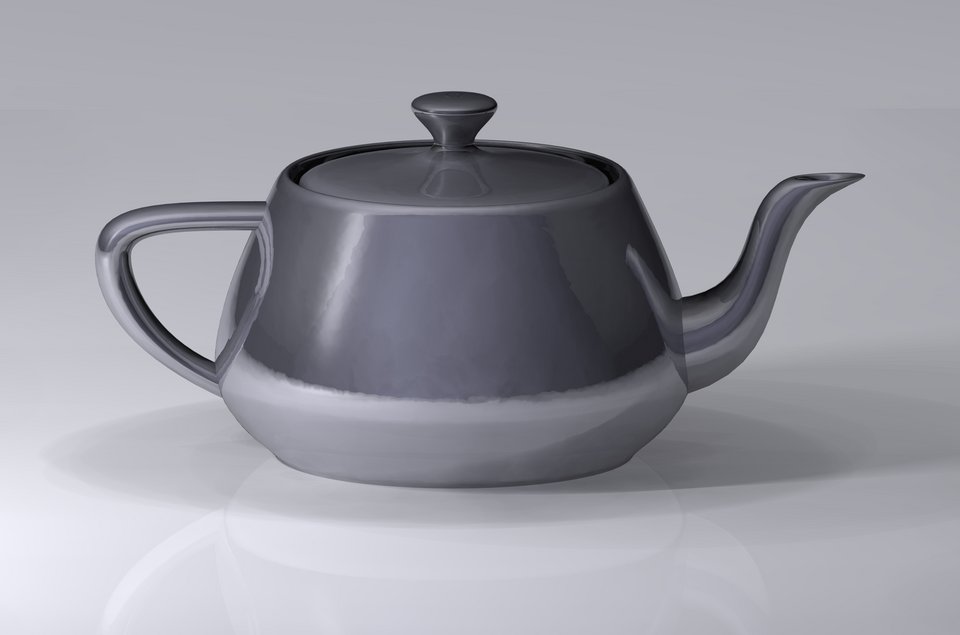
- 1975, the Utah teapot: Martin Newell models a teapot at the University of Utah. It becomes the "hello world" of computer graphics, and it is still a default object in many 3D programs.
- 1982, Star Trek II: the Genesis sequence, made by the Lucasfilm Computer Division (the group that became Pixar), is a minute of fully computer-generated images.
- 1982, Tron: about fifteen minutes of computer animation. It got no visual effects nomination; director Steven Lisberger said the Academy thought using computers was cheating, while animator Bill Kroyer remembers that voters simply did not understand what they were looking at.
- 1985, Young Sherlock Holmes: a knight made of stained glass steps out of a window. ILM's computer group, with John Lasseter animating, made the first fully computer-generated character in a feature film.
- 1989, The Abyss: ILM's water pseudopod copies the faces of the actors. It wins the Oscar.
 1982: Tron, how was it made?
 Westworld (1973): the first digital image
 Young Sherlock Holmes: the stained-glass knight
 The Abyss: the water pseudopod
15. The digital revolution: T2, Jurassic Park, The Matrix
Terminator 2: Judgment Day (1991): ILM's liquid-metal T-1000 walks out of fire and through bars. A computer-generated character now shared the screen with the actors for whole shots.
Jurassic Park (1993): the dinosaurs were planned in go-motion by Phil Tippett. Then Dennis Muren's team at ILM showed Spielberg a test of a computer-generated T-rex, and the plan changed. Tippett stayed on to direct the animators, Stan Winston's full-size animatronics did the close-ups, and the mix of the two is why the film still holds up. It won the Oscar, and it changed the industry overnight.
Toy Story (1995) was the first feature film made entirely with computer animation. Titanic (1997) put digital crowds, water and a digital ship in one of the biggest hits ever. The Matrix (1999) invented bullet time: a ring of still cameras fired in sequence, with the gaps between them filled by interpolation and the backgrounds rebuilt in CG. It won the Oscar over Star Wars: Episode I.
Between those milestones, more firsts:
- 1988, Willow: ILM's digital morphing, one creature turning into another without a dissolve.
- 1988, Who Framed Roger Rabbit: hand-drawn cartoons, animated by Richard Williams' team, that touch, push and cast shadows on the live action, all composited optically by ILM. An Oscar and a Special Achievement Award.
- 1994, Forrest Gump: Tom Hanks inserted into archive footage next to presidents, Gary Sinise's legs digitally removed, and the feather of the opening. Invisible effects win the Oscar.
- 1996, Independence Day: models and CG together at a huge scale, Oscar.
- 2000, The Perfect Storm: ILM's computer-generated ocean and wave, one of the first big fluid simulations in a film.
 Creating the T-1000 effects for Terminator 2
 How did they get the CGI in Jurassic Park to look so good?
 What is bullet time? The Matrix behind the scenes
 Willow (1988): morphing at ILM
 Who Framed Roger Rabbit: behind the ears
 The hidden VFX of Forrest Gump
16. The machines of the digital studio
The digital revolution also needed new tools, and many of them came from television and editing before film:
- Quantel (UK, from 1973): the DFS 3000 digital framestore (1975), the Paintbox (1981) and Harry (1985), the first all-digital system to edit and add effects to video. For years "Quantel" meant digital post-production.
- Avid Media Composer (1989): non-linear editing. Film was scanned at low resolution, cut on a computer, and the decisions sent back to the lab as an EDL. Editors could try anything without cutting film.
- Adobe Photoshop (1990): created by Thomas Knoll and his brother John Knoll, who worked at ILM. It became the matte painter's tool.
- Kodak Cineon (early 1990s): scanning film to digital files and recording it back, with the log .cin format that compositors still meet.
- Discreet Logic Flame (1993): compositing and finishing on Silicon Graphics workstations; later Inferno, then Autodesk.
- Maya (1998), from Alias|Wavefront: the 3D package that became the industry standard for animation and modelling.
17. Compositing goes digital: Shake and Nuke
Once film could be scanned and recorded back, the optical printer was replaced by software. In the 1990s and 2000s Shake, by Nothing Real and later Apple, was the node-based compositor of many big films, until Apple stopped developing it.
Nuke was born inside Digital Domain in the early 1990s as an in-house tool. In 2002 its developers (Bill Spitzak, Paul Van Camp, Jonathan Egstad and Price Pethel) received an Academy Technical Achievement Award; from 2007 The Foundry developed and sold it, and in 2018 the Academy honoured Nuke again with a Scientific and Engineering Award. Its multi-channel, linear-light, node-based design is why it became the standard. This site is mostly about it: start from the tutorials or the guide What Is Compositing.
18. Digital characters and performance capture
In The Lord of the Rings: The Two Towers (2002) Weta Digital's Gollum was driven by Andy Serkis's performance on set and in capture, then refined by animators: the first digital character to give a real performance. Weta also built Massive, the software that let thousands of soldiers think for themselves. The trilogy won three Oscars for visual effects in a row.
The Curious Case of Benjamin Button (2008) gave Brad Pitt an aged digital head for the first part of the film (Digital Domain). Avatar (2009) took performance capture to a whole world, and Weta FX won again with both its sequels, The Way of Water and Fire and Ash.
- 2004, The Polar Express: a whole film animated from motion capture of the actors, Tom Hanks in several roles.
- 2006, Pirates of the Caribbean: Dead Man's Chest: ILM captures Bill Nighy on set, in costume with markers, among the other actors; Davy Jones is entirely digital and wins the Oscar.
- 2009, Avatar: besides performance capture of body and face, the virtual camera: James Cameron could look through a screen and see the actors already as Na'vi inside the digital world, in real time.
- 2011, Rise of the Planet of the Apes: performance capture leaves the stage and goes on location: Andy Serkis as Caesar, among the real actors.
 Creating Gollum again
 ILM: animating Davy Jones
 Avatar: performance capture
 Rise of the Planet of the Apes: Weta featurette
19. The physics of light: Gravity and Interstellar
By the 2010s the question was no longer "can we make it?" but "is it physically right?". Inception (2010, Double Negative) folded Paris over itself with as much in camera as possible. For Gravity (2013) Framestore lit the actors inside a box of LED panels showing the CG environment, years before LED volumes had a name.
For Interstellar (2014) the team at DNEG wrote a renderer for light bending around a spinning black hole, working with the physicist Kip Thorne; the images were good enough to become a scientific paper. All three films won the Oscar.
 Interstellar: building a black hole
20. The price of the work: Life of Pi and Rhythm & Hues
In February 2013 Rhythm & Hues, the studio behind the tiger of Life of Pi, filed for bankruptcy. Days later the film won the Oscar for visual effects, while hundreds of artists protested outside the ceremony. It made everyone talk, for the first time in public, about fixed bids, tax incentives and studios moving around the world: the problems that still shape our job. I write about them in Working in VFX.
 The visual effects crisis
21. LED volumes and virtual production
For First Man (2018) DNEG put a huge LED screen outside the capsule windows, so the actors saw space and the light was real: it won the Oscar. For The Mandalorian (2019) ILM's StageCraft wrapped the set in LED walls driven by a game engine, with the background moving correctly with the camera. Part of the work moved from post-production to the shooting day, and compositors now also clean up seams, moiré and screen colour.
 The virtual production of The Mandalorian, season one
22. Today: small teams, Dune and machine learning
Godzilla Minus One (2023) won the Oscar with a small team at Shirogumi led by the director himself, Takashi Yamazaki: the first director to win it since Kubrick. Big budgets are not the only way.
Dune: Part Two (2024) won with DNEG, and I was a member of the DNEG compositing team on the film: you can see some of that work in my portfolio. The 98th Oscars went to Avatar: Fire and Ash.
Now machine learning is entering every step: rotoscoping, depth, relighting, denoising, upscaling, generative tools. It looks like a revolution, and it is; but so were the optical printer, the blue screen and the computer. Every time, the tools changed and the eye stayed the most important one. More on the tools in Machine learning, AI and ComfyUI.

 The visual effects of Godzilla Minus One
 Dune: Part Two, DNEG
23. The studios that made VFX history
Behind the films there are a few companies where most of the techniques were invented, and where most of today's supervisors trained. Many artists, me included, have moved between them for years.
- Industrial Light & Magic: Founded by George Lucas in 1975 for Star Wars. Motion control, the first CG characters, morphing, the T-1000, the dinosaurs, StageCraft. Part of Lucasfilm and Disney since 2012, with studios in San Francisco, Vancouver, London, Sydney and Mumbai.
- Pixar: Born in 1986 when Steve Jobs bought Lucasfilm's computer division. RenderMan, the renderer behind decades of visual effects, and Toy Story, the first fully CG feature. Part of Disney since 2006.
- Digital Domain: Founded in 1993 by James Cameron, Stan Winston and Scott Ross. Titanic, Benjamin Button, and the birthplace of Nuke.
- Wētā FX: Founded in Wellington in 1993 as Weta Digital by Peter Jackson, Richard Taylor and Jamie Selkirk. The Lord of the Rings, King Kong, the Avatar films and the Planet of the Apes trilogy. Renamed Wētā FX in 2021, when Unity bought its software tools.
- Framestore: Founded in London in 1986. Gravity, The Golden Compass, Paddington, and many of the Marvel films; studios in London, Montreal, Mumbai and more.
- DNEG: Founded in London in 1998 as Double Negative, merged with Prime Focus World in 2014. Inception, Interstellar, Ex Machina, First Man, Tenet, Dune and Dune: Part Two.
- MPC: The Moving Picture Company, London, 1970. The Jungle Book and 1917. It closed with the collapse of the Technicolor group in February 2025.
- Rhythm & Hues: Los Angeles, 1987. Babe, The Golden Compass, Life of Pi; bankrupt in 2013, days before its Oscar.
- Sony Pictures Imageworks: Founded in 1992. The Spider-Man films, The Polar Express, and now mostly animation.
- Cinesite, Animal Logic, Scanline, Rodeo FX, Image Engine: The next generation of studios: Cinesite (London, 1991), Animal Logic (Sydney, 1991, bought by Netflix in 2022), Scanline (Munich, 1989, merged into Netflix's Eyeline in 2025), Image Engine (Vancouver, 1995), Rodeo FX (Montreal, 2006).
For today's studios, their size and how to work there, see the studios to know and the studios that closed in Working in VFX.
24. 50 films every VFX artist should watch
Fifty films, in order, that changed what visual effects could do. Watch them knowing what to look for: each image opens a video about how the effects were made.
Méliès: substitutions, multiple exposure, painted sets.
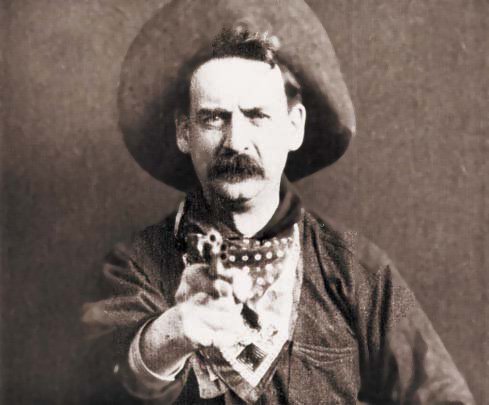
Matte shots on the original negative.
Willis O'Brien's stop-motion dinosaurs.
The Schüfftan process and huge miniatures.
A creature that acts; miniature rear projection.

Colour blue screen travelling mattes, Oscar.

Linwood Dunn's optical printer, hidden in plain sight.

The parting of the Red Sea, Oscar.

The dolly zoom, and a bell tower that was never there.

Petro Vlahos' colour-difference blue screen, Oscar.

Ray Harryhausen's skeleton fight.

The sodium vapour process, Oscar.

Front projection and slit-scan, Oscar.

The first digital image processing in a film.

Animatronics, and the power of what you don't show.

ILM is born; motion control, Oscar.

Douglas Trumbull's cloud tank and mothership.

Zoptic front projection: a man can fly.

Giger and Rambaldi's creature, Oscar.

Miniatures, smoke and light: the city of the future.

Fifteen minutes of computer animation.

The Genesis sequence: fractals and particles.

The first fully CG character.

Cartoons that touch live action, Oscar.

Digital morphing.

The water pseudopod, Oscar.

The liquid-metal T-1000, Oscar.

CG creatures with animatronics, Oscar.

Invisible effects in archive footage, Oscar.

The first fully computer-animated feature.

A digital ship, digital water, digital crowds, Oscar.

Bullet time, Oscar.

Massive crowds and forced perspective, Oscar.

Gollum, the first great digital performance, Oscar.

Digital doubles and Doc Ock, Oscar.

Davy Jones, captured on set, Oscar.

A digital human head, Oscar.

Performance capture and the virtual camera, Oscar.

The folding city, and practical effects first, Oscar.

Performance capture on location.

Richard Parker, the CG tiger, Oscar.

The light box: LED light before LED volumes, Oscar.

A black hole rendered from physics, Oscar.
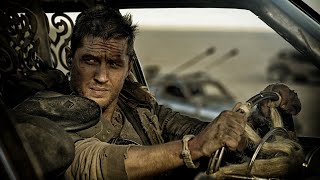
Real stunts, invisibly extended.

Holograms and a digital Rachael, Oscar.

StageCraft: the LED volume.

Sand-coloured screens instead of blue, Oscar.

Performance capture under water, Oscar.

A small team wins the Oscar.

DNEG, Oscar; I was in the compositing team.
25. Quiz: how much VFX history do you know?
Ten questions from this page. Click an answer: green is right, red is wrong.
1. Which film showed the first fully computer-generated character?
2. The Two Ways of Life (1857) was printed from about how many negatives?
3. Who perfected the colour-difference blue screen?
4. Which film won the very first Oscar for special effects (films of 1939)?
5. In which year was ILM founded?
6. What was the mechanical shark of Jaws nicknamed?
7. Where was Nuke born?
8. Who holds the record for visual effects Oscars?
9. Which film introduced bullet time?
10. Which Oscar winner put a huge LED screen outside the windows of a spacecraft?
Score: 0 / 10
26. Visible and invisible effects: a little theory
Where does a "trick" end and normal filmmaking begin? A cut, after all, was itself a trick in 1900. The French film theorist Christian Metz proposed two ways to sort effects. The first by when they happen: in front of the camera (what Hollywood calls special effects: explosions, models, makeup), or through the camera and the lab (what we call visual effects). The second by how the audience perceives them:
- Imperceptible: you are not supposed to notice them at all, like a stunt double or a removed safety cable.
- Invisible but perceptible: you know it can't be real, but you can't see how it was done: the tornadoes of Twister (1996).
- Visible: the effect is part of the language and shows itself, like slow motion or a dissolve.
Digital effects blurred both lines. Almost everything now happens in post-production, and invisible work became the biggest part of the job: the bell tower of Vertigo was an invisible effect, and so are the legs removed from Gary Sinise in Forrest Gump or the safety cable painted out while Tom Cruise climbs in Mission: Impossible 2 (2000). The feather of Forrest Gump is different: it is invisible as a technique, but it makes you wonder how it was done. The best compositing is usually the work nobody knows is there.
27. Every Oscar for visual effects
The Academy started with Best Special Effects for the films of 1939 (it also rewarded sound effects until the early 1960s). The category became Best Special Visual Effects in 1965 and Best Visual Effects from the films of 1977. In some years only a Special Achievement Award was given (marked SA). Years are the films' release years; the ceremony is the following spring.
| year | film | year | film | year | film |
|---|---|---|---|---|---|
| 1939 | The Rains Came | 1968 | 2001: A Space Odyssey | 1997 | Titanic |
| 1940 | The Thief of Bagdad | 1969 | Marooned | 1998 | What Dreams May Come |
| 1941 | I Wanted Wings | 1970 | Tora! Tora! Tora! | 1999 | The Matrix |
| 1942 | Reap the Wild Wind | 1971 | Bedknobs and Broomsticks | 2000 | Gladiator |
| 1943 | Crash Dive | 1972 | The Poseidon Adventure (SA) | 2001 | The Lord of the Rings: The Fellowship of the Ring |
| 1944 | Thirty Seconds Over Tokyo | 1973 | not awarded | 2002 | The Lord of the Rings: The Two Towers |
| 1945 | Wonder Man | 1974 | Earthquake (SA) | 2003 | The Lord of the Rings: The Return of the King |
| 1946 | Blithe Spirit | 1975 | The Hindenburg (SA) | 2004 | Spider-Man 2 |
| 1947 | Green Dolphin Street | 1976 | King Kong, Logan's Run (SA) | 2005 | King Kong |
| 1948 | Portrait of Jennie | 1977 | Star Wars | 2006 | Pirates of the Caribbean: Dead Man's Chest |
| 1949 | Mighty Joe Young | 1978 | Superman (SA) | 2007 | The Golden Compass |
| 1950 | Destination Moon | 1979 | Alien | 2008 | The Curious Case of Benjamin Button |
| 1951 | When Worlds Collide (SA) | 1980 | The Empire Strikes Back (SA) | 2009 | Avatar |
| 1952 | Plymouth Adventure (SA) | 1981 | Raiders of the Lost Ark | 2010 | Inception |
| 1953 | The War of the Worlds (SA) | 1982 | E.T. the Extra-Terrestrial | 2011 | Hugo |
| 1954 | 20,000 Leagues Under the Sea | 1983 | Return of the Jedi (SA) | 2012 | Life of Pi |
| 1955 | The Bridges at Toko-Ri | 1984 | Indiana Jones and the Temple of Doom | 2013 | Gravity |
| 1956 | The Ten Commandments | 1985 | Cocoon | 2014 | Interstellar |
| 1957 | The Enemy Below (sound effects) | 1986 | Aliens | 2015 | Ex Machina |
| 1958 | Tom Thumb | 1987 | Innerspace | 2016 | The Jungle Book |
| 1959 | Ben-Hur | 1988 | Who Framed Roger Rabbit | 2017 | Blade Runner 2049 |
| 1960 | The Time Machine | 1989 | The Abyss | 2018 | First Man |
| 1961 | The Guns of Navarone | 1990 | Total Recall (SA) | 2019 | 1917 |
| 1962 | The Longest Day | 1991 | Terminator 2: Judgment Day | 2020 | Tenet |
| 1963 | Cleopatra | 1992 | Death Becomes Her | 2021 | Dune |
| 1964 | Mary Poppins | 1993 | Jurassic Park | 2022 | Avatar: The Way of Water |
| 1965 | Thunderball | 1994 | Forrest Gump | 2023 | Godzilla Minus One |
| 1966 | Fantastic Voyage | 1995 | Babe | 2024 | Dune: Part Two |
| 1967 | Doctor Dolittle | 1996 | Independence Day | 2025 | Avatar: Fire and Ash |
The Academy's own awards database lists every nominee, and the full credits for each year.
Records: who won the most
The Oscar goes to up to four people per film, usually the VFX supervisors, the animation supervisor and the special effects supervisor on set. These are the names that come back most often:
| Oscars | who |
|---|---|
| 8 | Dennis Muren (ILM): the record, from 15 nominations, from The Empire Strikes Back to Jurassic Park |
| 6 | Joe Letteri (Wētā FX): two Lord of the Rings films, King Kong and all three Avatar films |
| 5 | Gordon Jennings, Ken Ralston |
| 4 | L. B. Abbott, Richard Edlund, Glen Robinson, Paul Lambert (Blade Runner 2049, First Man, Dune, Dune: Part Two) |
| 3 | Richard Baneham, Randall William Cook, Farciot Edouart, John P. Fulton, Alex Funke, A. Arnold Gillespie, Robert Legato, Andrew Lockley, Louis Mesenkop, Gerd Nefzer, Carlo Rambaldi, Jim Rygiel, Stan Winston |
- Most nominations: Dennis Muren, 15. Most nominations without a win: Dan Sudick, 13.
- Oldest winner: L. B. Abbott, 68, for Logan's Run. Youngest winner: Tatsuji Nojima, 25, for Godzilla Minus One.
- Franchises with the most wins: Star Wars, Middle-earth and Avatar, three each. Most nominations: the Marvel Cinematic Universe, 14, still without a win.
28. Videos to watch
Georges Méliès: Master of IllusionCrash Course Film History.
Also worth finding: Light & Magic (2022), Lawrence Kasdan's documentary series on the history of ILM, on Disney+.
29. Books on the history of VFX
The links search each book on Amazon.
- Special Effects: The History and TechniqueRichard RickittThe whole story, technique by technique, from Méliès to CG.
- The Invisible Art: The Legends of Movie Matte PaintingMark Cotta Vaz, Craig BarronMatte painting, the ancestor of every set extension.
- Industrial Light & Magic: The Art of Special EffectsThomas G. SmithILM's first decade, from Star Wars on.
- Industrial Light & Magic: Into the Digital RealmMark Cotta Vaz, Patricia Rose DuignanThe move to digital: The Abyss, T2, Jurassic Park.
- Droidmaker: George Lucas and the Digital RevolutionMichael RubinHow Lucasfilm's computer division started digital cinema, and Pixar.
- Creativity, Inc.Ed Catmull, Amy WallaceFrom the University of Utah to Pixar, told by one of the inventors.
- Ray Harryhausen: An Animated LifeRay Harryhausen, Tony DaltonDynamation, in the words of its inventor.
- Masters of FXIan FailesInterviews with the supervisors behind modern classics.
- The VES Handbook of Visual EffectsJeffrey A. Okun, Susan ZwermanThe industry's reference, from the Visual Effects Society.
For compositing books, see my compositor's bookshelf.
30. Sources and image credits
- Academy Award for Best Visual Effects: winners and nominees
- The Academy Awards database
- Visual effects: history and techniques
- The Execution of Mary Stuart (1895)
- Georges Méliès
- Matte painting and Norman Dawn's glass shots
- Rotoscoping and Max Fleischer's patent
- The Schüfftan process
- The optical printer
- Chroma key, blue and green screen
- Petro Vlahos
- Ray Harryhausen
- Slit-scan photography
- Industrial Light & Magic
- Motion control photography
- The Utah teapot
- Why Tron didn't get a VFX Oscar nomination (Film Stories)
- Nuke at the Sci-Tech Oscars (fxguide)
- Rhythm & Hues Studios
- StageCraft and LED volumes
- The Visual Effects Society
- Image: The Horse in Motion (public domain)
- Image: The Execution of Mary Stuart (public domain)
- Image: The Great Train Robbery (public domain)
- Image: A Trip to the Moon (public domain)
- Image: Fleischer's rotoscope patent (public domain)
- Image: Metropolis poster by Boris Bilinsky (public domain)
- Image: The Lost World (public domain)
- Image: King Kong poster (public domain)
- Image: optical printer by Carl Louis Gregory (public domain)
- Image: Utah teapot by Dhatfield (CC BY-SA 3.0)
- Image: green screen studio by Colin and Sarah Northway (CC BY 2.0)
- Image: The Two Ways of Life, Rejlander (public domain)
- Image: Fading Away, Robinson (public domain)
- Image: Boulevard du Temple, Daguerre (public domain)
- Image: Kinetoscope patent (public domain)
- Image: the Cinématographe by Victorgrigas (CC BY-SA 4.0)
- Image: The One-Man Band, Méliès (public domain)
- Image: The Man with the Rubber Head, Méliès (public domain)
- Combination printing: Rejlander and Robinson
- The Cinématographe
- Quantel
- Christian Metz
- What Is Compositing: the compositor's roadmap
- Working in VFX: how to get a job